How the purchasing process works
Introduction
The Purchases functionality in 1C:Gestión Integral helps organize supplier transactions and link commercial, warehouse and payment documents.
Not every purchase requires the same set of documents. For example, a purchase can be recorded directly through a Purchase Invoice without first creating a Purchase Order. The physical receipt of goods and the recording of an invoice are separate operations.
Purchasing process diagram
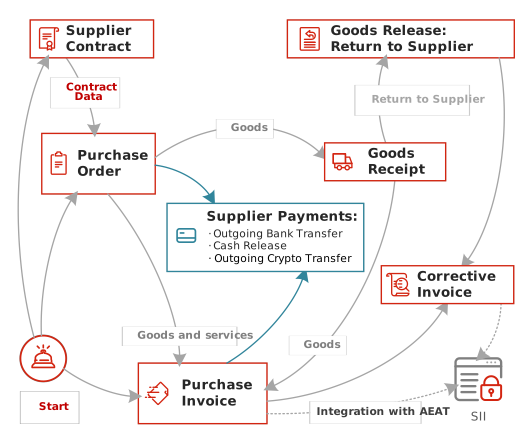
The diagram shows the main documents and possible paths for goods, services, returns and payments.
Main documents and operations
Supplier Contract
A supplier contract records the terms agreed with a supplier and provides a reference for transactions. Not every purchase requires a prior contract.
Purchase Order
A Purchase Order identifies goods or services requested from a supplier and helps organize the transaction before their receipt or invoicing.
Goods Receipt Note
A Goods Receipt Note records the physical arrival of goods at a warehouse. Goods receipt and invoice recording should be considered separately: one concerns inventory movement, while the other documents the purchase.
Service purchases do not involve a physical receipt of goods.
Purchase Invoice
A Purchase Invoice records the supplier's invoice and the amounts for purchased goods or services. It can be recorded without a previous Purchase Order.
Recording the invoice and paying it are separate operations, making it possible to track outstanding amounts.
Supplier payments
Supplier payments can be recorded through financial documents such as Outgoing Bank Transfer, Cash Payment or Outgoing Crypto Transfer. Linking payments to invoices helps track amounts owed to suppliers.
Returns and corrective invoices
Goods returned to the supplier are recorded using the Return to Supplier operation in a goods release document. When an invoice needs correction, a Corrective Purchase Invoice is used.
These are distinct operations: one records the movement of goods, while the other corrects invoicing.
AEAT integration
The diagram also includes integration with the SII. Whether it applies depends on the company's tax obligations and settings.
Common scenarios
Purchase with an order and goods receipt
Supplier Contract (optional) → Purchase Order → Goods Receipt Note → Purchase Invoice → Supplier Payment.
This separates the order, physical receipt, invoice and payment.
Direct purchase of goods or services
Purchase Invoice → Supplier Payment.
This can be used when a Purchase Order is unnecessary. If goods must be added to warehouse stock, their receipt must also be recorded.
Payment before the invoice
Supplier Payment → Purchase Invoice.
An advance payment and the subsequent invoice are separate transactions that need to be linked for accurate balance tracking.
Return to supplier
Return to Supplier and, where appropriate, Corrective Purchase Invoice.
One or both documents may be needed depending on whether goods are returned, invoicing is corrected, or both.
Tracking the process
To understand the status of a purchase, distinguish what was ordered, physically received, invoiced and paid. Quantities and amounts may differ at any given time.
Related documents help review each aspect without treating a goods receipt as an invoice or a payment.